Launching on Base: A founder's guide for selecting a launchpad
Kevin Jung · Cezar Cocias · Vano Narimanidze ·
At Ventari, we’ve supported numerous institutional token launches throughout the years, with well-funded teams with foundation-issued tokens, major marketing campaigns, and day-one top-tier CEX listings. While the scale of these rollouts is vastly different from launching a token on a permissionless launchpad, the underlying mechanics and operational planning principles still apply.
Although permissionless launchpads are often dismissed as whimsical, "degen" plays, the reality couldn’t be further from the truth. Whether you are raising millions or deploying permissionlessly, you still only get one shot at a successful token debut. Regardless of scale, proper effort must go into tokenomics, liquidity, discoverability, and operational planning.
Currently, the Base launchpad market has consolidated around five options: Clanker, Bankr, Virtuals, Flaunch, and OpenServ. While launching on a Base launchpad is structurally simple, the strategic choices behind it are not. Each platform bakes a distinct theory of token economics into its configuration - dictating founder allocation, post-launch liquidity, treasury runway, listing pathways, and ultimately price action. Because these smart contracts are immutable, you cannot afford an underprepared rollout.
We wrote this guide because these critical mechanics shouldn't be a secret. If it saved you from a single structural pitfall, it was worth the read. And if you would rather skip the guesswork entirely and design a bulletproof launch from the start, that is exactly what we are here for. It’s best to get things right the first time.
What's inside this article:
- Part 1: Base Launchpad Landscape
- Launchpad Comparison – Side-by-side comparison of the launchpads.
- Choosing a Launchpad – Launchpad decision tree based on project goals.
- Part 2: Pre-Launch Architecture
- Supply and Fee Economics – Where every dollar of swap fees actually goes.
- DEX Pool Setup – Pool setup and how it dictates the rest of your launch.
- Tokenomics Planning – Rethinking the classic token distribution.
- Solving for Founder Allocation – Reserving operational and team supply.
- Part 3: Post-Launch Reality and Survival
- Launch Liquidity – Managing liquidity with a locked primary LP.
- Price Action Scenarios – The distinctive chart each launchpad produces.
- Maintaining Liquidity Health – The post-launch metrics that matter
- Traps to Avoid – Failure patterns we see repeat.
- Part 4: Scaling
- Market Makers and Exchanges – Comes after launch but worth preparing for.
Part 1: Launchpad Landscape
Launchpad Comparison
Every launchpad on Base is built with a specific token archetype in mind. Here is a high-level breakdown of the top five platforms, their defining mechanics, and exactly what kind of project they are engineered to support, or actively punish.
| Launchpad | Signature design | Best for | Avoid if you need |
|---|---|---|---|
| Clanker | X% Creator, .2X% Clanker, V3/V4 staircase LP, Farcaster-native | Viral memecoins, narrative trades | Predictable sell-side depth at launch |
| Bankr | 1.2% swap fee, 57% creator share, fee decays 80% → 1.2% in 10s | X-native launches, agent tokens | Multi-party cap tables (by default) |
| Virtuals | 1% tax, bonding curve → V2/Meteora paired vs VIRTUAL, 10yr LP lock | AI agent ownership, multi-year holds | Direct fiat-pair price signal |
| Flaunch | 1% fee, up to 100% to creator + buybacks, fixed-price fair launch | Established communities, anti-bot launches | Speed-to-market |
| OpenServ | Bonding curve → Aerodrome at 10 ETH, custom cap tables, accelerator gating | Real products, RWAs, B2B | Permissionless speed |
Choosing a Launchpad
The synthesis as a decision tree - treat the tree below as a starting point and not a rulebook. These categories overlap, and strong teams have launched successfully across all five pads - a real product with a custom cap table, for example, can absolutely launch on Bankr rather than OpenServ.
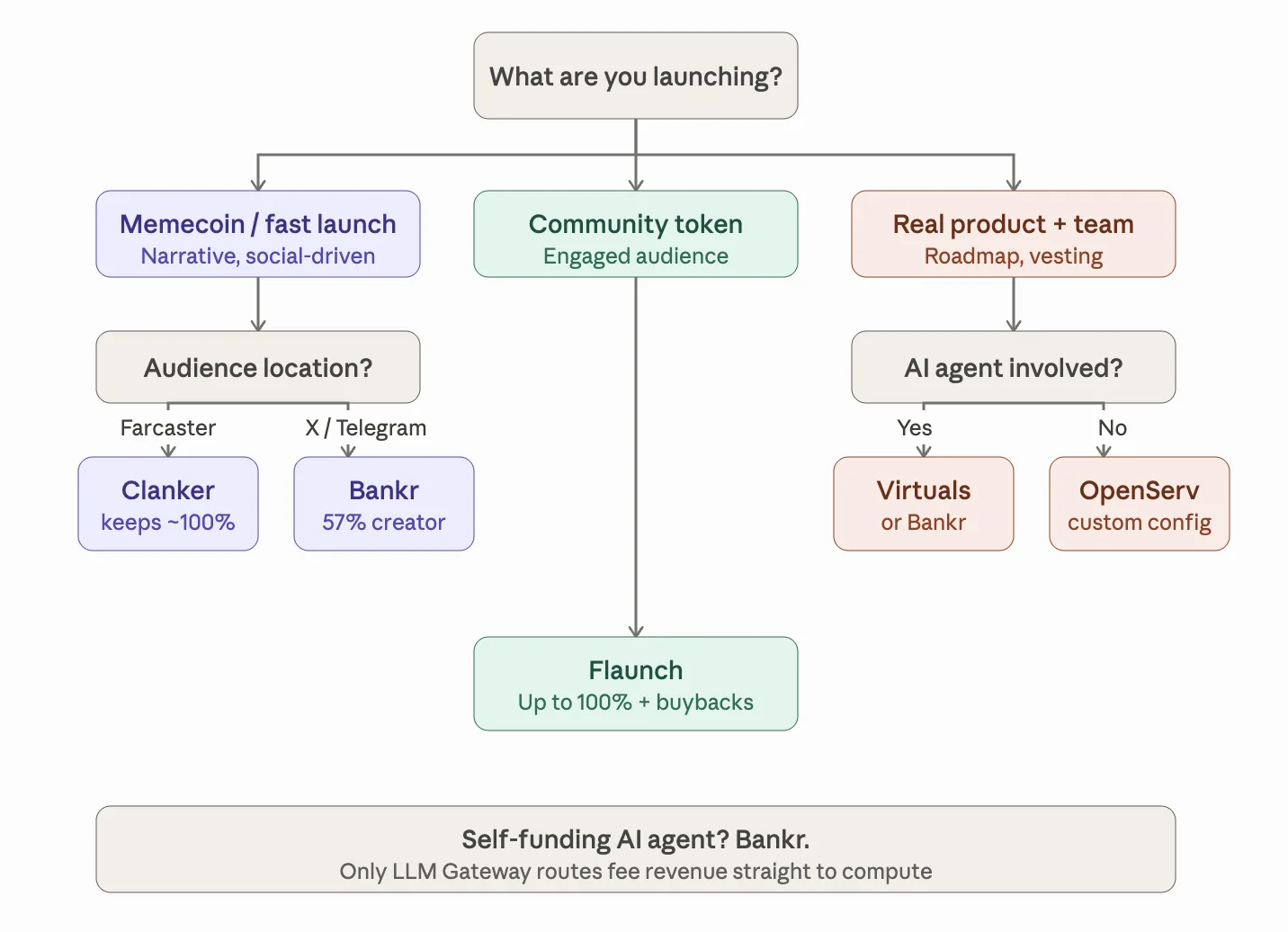
| Your goal | Launchpad | Why |
|---|---|---|
| Viral distribution, narrative trading | Clanker or Bankr | Easiest social onboarding; Farcaster vs X choice |
| Anti-bot, protected capital formation | Flaunch | Fixed-price fair-launch window is the best anti-snipe in the market |
| AI co-ownership, agent IP | Virtuals | Designed specifically for tokenizing autonomous agents |
| Enterprise B2B, SaaS with token utility | OpenServ | Token utility tied to full-stack AI business operations |
| Real product, custom cap table | OpenServ or Bankr (custom config) | Vesting, cliffs, treasury structures handled natively |
| Self-funding AI agent | Bankr | LLM Gateway routes fee revenue directly to compute |
Part 2: Pre-Launch Architecture
Supply and Fee Economics
The long-term viability of your project depends heavily on how your launch vehicle captures and distributes value. Here is the architectural breakdown of swap fees, protocol cuts, and supply configuration across the top five platforms.
| Launchpad | Swap fee | Creator keeps | Launch supply | Protocol take | Fee recipients |
|---|---|---|---|---|---|
| Clanker | 1.2% (creator sets 1%, protocol adds 20% on top) | 100% of creator fee via clanker.world, 80% via Farcaster bot | Configurable: full supply to LP by default, or carve out a vault allocation at deploy | 20% of LP fees, on top | Up to 7, immutable |
| Bankr | 1.2% (decays from 80% over 10s) | 57% | 100% to LP by default; custom vesting available via DERC20 | 43% to Bankr + ecosystem, of which 5% is Doppler's protocol fee | Fee recipient/admin can be set in the launch flow; no built-in multi-party cap table by default |
| Virtuals | 1% trading tax | Flows to the agent wallet to fund compute, not a direct cut | 100% to bonding curve; no team pre-mine by default (pre-buy is a separate module) | 1% tax routes to treasury (prototype) then agent wallet (post-graduation) | N/A |
| Flaunch | 1% | Up to 100% (creator sets the split; remainder funds buybacks) | Configurable fair-launch supply at a fixed price; optional premine | 0% on swaps | Unlimited, NFT-transferable |
| OpenServ | Per-project | Per-project | Custom cap table set at launch (team, vesting, treasury) | Platform volume drives SERV buyback + burn | Per-project |
The launchpads fall into very distinct camps regarding how they reward creators versus how much the protocol takes, fundamentally dictating long-term runway:
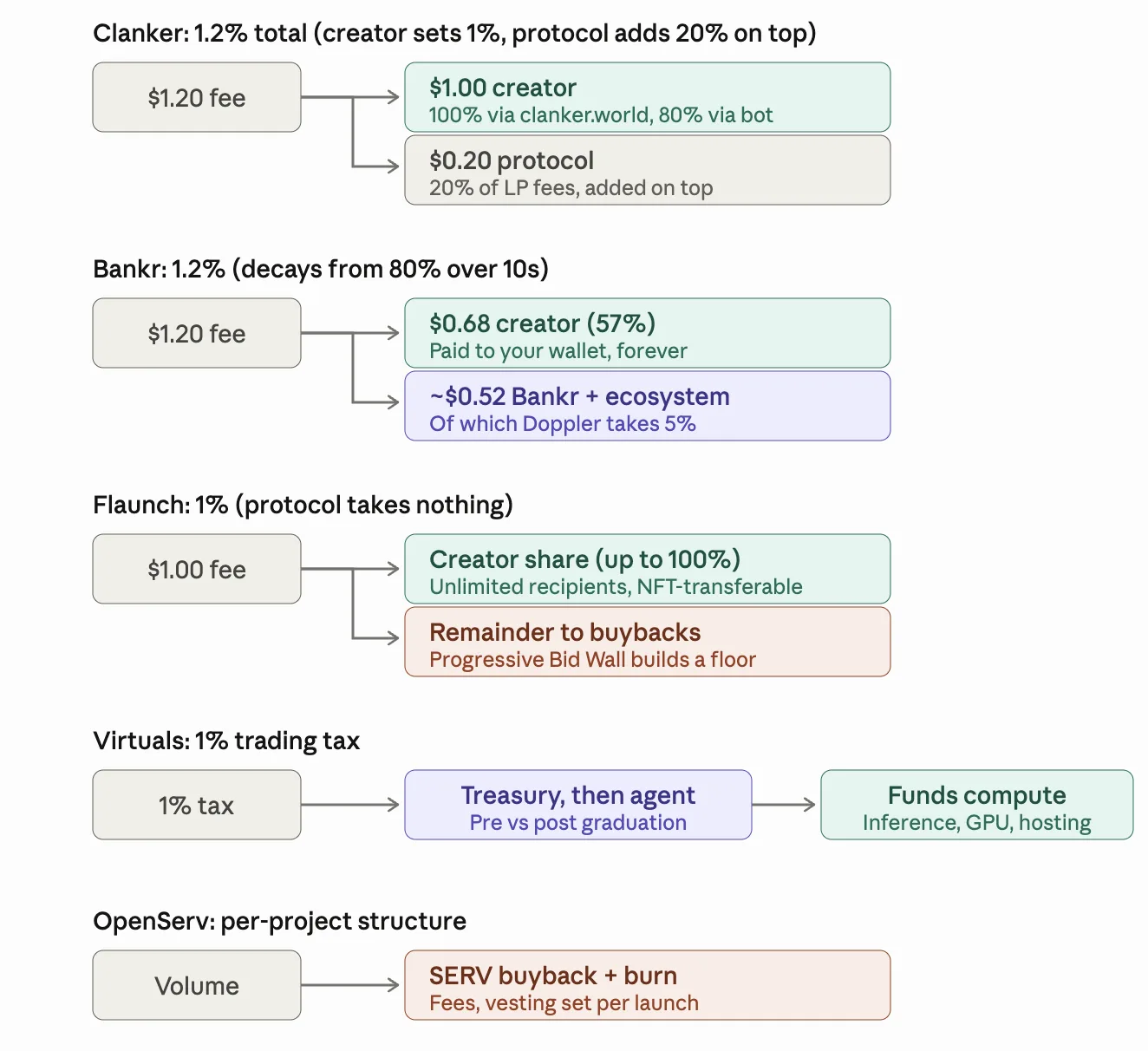
- Clanker: Among the highest creator payouts. A founder routing through clanker.world keeps the entire creator fee, with the protocol adding its 20% cut on top rather than deducting it from your share.
- Bankr: Retains 57% for the creator and allocates the rest to its own ecosystem, with Doppler taking a 5% infrastructure fee from that pool.
- Flaunch: Highly creator-friendly, taking 0% on swaps. This lets you claim the full 1% fee or redirect it entirely into automated token buybacks.
- Virtuals: Built differently. There is no traditional creator "cut" because the 1% tax routes directly to the agent’s own wallet to fund its decentralized compute.
When it comes to launch supply, the spectrum runs from immediate, 100% market float to highly customized cap tables:
- Full Market Float (Bankr and Virtuals): These platforms default to putting the entire supply on the open market. A founder who wants operational or team tokens must execute a deliberate post-launch strategy to acquire them.
- Pre-Mined Splits (Clanker and Flaunch): These allow you to carve out or pre-mine a specific portion of the supply right at the moment of deployment.
- Custom Cap Tables (OpenServ): The only option engineered around a traditional cap table from day one, allowing you to hardcode specific allocations for team vesting and treasury.
All of the fee-routing mechanics detailed in the table apply only to the primary liquidity pool created by the launchpad. If secondary pools are opened later on other DEXs (by you or third parties), they operate under standard rules: the trading fees go to whoever supplied that liquidity, and your creator wallet sees none of it.
This introduces two massive practical consequences for growing projects:
- Fee Bleed: If trading volume shifts to a deeper, third-party pool, the fee revenue you were counting on can dry up completely - even if your token's total trading volume looks incredibly healthy.
- Market Maker Reality: If you eventually bring in an external market maker, the pools they run on separate venues will not feed your launchpad fee stream. Their compensation and capital requirements must be planned independently rather than assuming they can be funded by your launchpad fees.
DEX Pool Setup
The liquidity pool your token launches into is not just a technical detail - it is the structural foundation of your entire market.
Here is exactly how each launchpad configures your initial liquidity, what kind of pool type it uses, and how permanently that capital is locked.
| Pool type | Liquidity design | LP holder | Mutability | |
|---|---|---|---|---|
| Clanker | Uniswap V3/V4 vs WETH | Single-sided "staircase," up to 7 bands | LP Locker V2 | Permanent |
| Bankr | Uniswap V4 vs WETH (Doppler) | One concentrated position, ~$27K-$1.66B range, 1% safety tail | Doppler initializer | Fully immutable (NoOpMigrator) |
| Virtuals | V2 (Base) / Meteora (Solana) vs VIRTUAL | Bonding curve → paired V2 LP | Staked, locked | 10 years |
| Flaunch | Two V4 positions | Wide-range token + single-tick flETH, expanded by PBW | Hook contract | Effectively burned |
| OpenServ | Aerodrome volatile pool | Bonding curve → standard Aerodrome | Varies (verify per launch) | Lightest of the five |
As the breakdown reveals, there is no "standard" DEX pool. Each platform engineers a completely bespoke liquidity environment - ranging from Clanker’s single-sided "staircase" of liquidity bands, to Bankr’s massive, concentrated Uniswap V4 position via Doppler, to Virtuals' custom base-pair bonding curve.
Because these distinct mechanics dictate how trades are processed and how market depth is calculated, failing to understand your pool’s exact structure can be a fatal error.
Before you click deploy, a three elements to internalize:
The TVL Illusion: A high Total Value Locked (TVL) number can be deceptive on day one. Clanker only seeds the initial pool with your token, not ETH - meaning there is no buy-side asset on the other side to absorb a sudden dump. A modest sell order can crater your price even when Dexscreener shows massive TVL. Conversely, Bankr, Flaunch, and Virtuals (post-graduation) place liquidity on both sides of the pool, meaning their TVL reflects what a trader can actually move. On Clanker, the screen lies: the number you see is not the depth you have.
The Base Asset Trap: Your trading pair is permanent, and its choice has massive downstream effects. Virtuals pairs your token against $VIRTUAL rather than ETH, which means your price is forever tethered to $VIRTUAL’s macro fluctuations. If $VIRTUAL drops, your token drops with it, regardless of your project's performance. The other four platforms price against ETH, providing a clean dollar signal that CEXs, partners, and your community can read without a second translation. The VIRTUAL pairing buys you into an ecosystem; just ensure it is an ecosystem you want to be permanently wedded to.
The Credibility Standard: Locked liquidity is non-negotiable for serious growth. It is the clearest signal to centralized exchanges that you cannot rug-pull your community-making it the very first thing their compliance teams check before a listing. While four of the five launchpads lock or burn the primary LP automatically, OpenServ is the exception. If you deploy there, you must manually confirm and prove to the market that your liquidity has actually been locked.
Tokenomics Planning
Founders coming from the foundation minted supply playbook instinctively reach for a classic distribution along the lines of: 15% team, 15% investors, 45% community, 15% ecosystem, and 10% liquidity. With permissionless launchpads, there isn’t that level of supply control on the outset.
However the underlying goals: funding the team, rewarding the community, and keeping the project alive remain identical. Classic tokenomics hasn't disappeared on Base launchpads; it has simply been compressed. In the old model, you designed a multi-year emission schedule for 100% of the supply because teams controlled the entire ledger from day one. Today, tokenomics is a two-part discipline.
You must still execute traditional tokenomics planning - vesting schedules, team-versus-advisor splits, and structural lockups-but applied strictly to the smaller allocation you secure for your project. Simultaneously, you must layer on operational architecture (fee routing, buyback parameters) to manage the immediate public float. If you do not plan both before you deploy, the market will dictate your runway for you.
| Old Model | New Model on Base Launchpads |
|---|---|
| Supply control (100%) | Strategic carve-outs (e.g., 10%) + market float |
| Allocation buckets | Traditional splits for your carve-out + Fee routing for the float |
| Vesting schedules | Smart contract vests for the team + Protocol-enforced buybacks |
| Treasury raise | Not via ecosystem allocations but rather through fee routing |
| Community airdrops | Initial manual distributions + Retroactive fee-funded ecosystems |
The reality of this planning plays out differently depending on the platform you choose:
- For Clanker and Flaunch: You can still execute classic tokenomics, but you must configure it upfront. These platforms allow you to pre-configure a specific team or operational allocation before the rest of the supply hits the liquidity pool.
- For Bankr: The platform defaults to a 100% market float on day one, but supply can still be obtained by the team after the fee decay, post-launch. Or through a custom config.
- For Virtuals: The token functions strictly as AI agent equity. Because there is no traditional creator pre-mine by default, fee revenue must directly offset compute costs and fund agent development. Agent uptime and on-chain activity drive valuation once launch hype fades; the agents that survive are simply the ones that keep working.
- For OpenServ: You are closest to the classic tokenomics model, but with a critical inversion. In the old model, the token captured value from the product. Here, the product needs the token to function (e.g., for governance, staking, and whitelisting). If your token isn't structurally necessary for your product to operate, OpenServ is the wrong launchpad, as speculative hype will not sustain the compute costs of running a real business.
Solving for Founder Allocation
By default, fair-launch infrastructure pushes the majority (or all) supply to the open market at T+0. This produces healthy holder distributions, but it can leave founders completely stranded. Operational reality requires supply for future market-making inventory, advisor allocations, partner incentives, and a treasury buffer to ride out the first major market drawdown without being forced to sell on the open market.
Sizing this allocation is a delicate psychological balancing act. Retain too little, and you run out of operational runway the moment a drawdown hits. Retain too much, and your own community reads it as a rug-pull risk and discounts the token at launch. Your allocation must be defensible, transparent, and small enough that a "team-will-dump" narrative never gains traction.
Securing this inventory requires working within the specific technical primitives of your chosen launchpad:
Founder Allocation Comparison by Launchpad
| Launchpad | Native mechanism | What it costs |
|---|---|---|
| Clanker | Vault config at deploy: carve out a configurable allocation, locked for a minimum 7 days | Zero token cost; transparent onchain |
| Bankr | DERC20 vesting primitive (custom configs); or simply wait 8-10 seconds for the fee decay and market-buy | Custom config requires coordination with team; market-buy costs slippage + fee |
| Virtuals | Pre-buy module through the bonding curve at the lowest curve price (explicitly documented) | Requires VIRTUAL inventory; Genesis launches cap individual wallets |
| Flaunch | FlaunchPremineZap at deploy: premine your own supply in the same transaction, before others can buy | ETH at the fixed fair-launch price; no slippage |
| OpenServ | Native cap-table support (the only launchpad here designed for it) | Configured at launch; no on-market acquisition needed |
Most of these launchpads have intended mechanisms for founders to acquire operational supply. Clanker's vault, Flaunch's premine, Virtuals' pre-buy, and OpenServ's cap-table support: all designed for legitimate founder allocations.
Bankr is the exception, as the default Bankr flow assumes the deployer is an agent that doesn't need founder supply, so human teams need to either configure a custom DERC20 vesting structure with the Bankr team (as LienFi did) or accept the wait-and-buy mechanic with its associated cost.
Discipline matters more than the mechanism: announce the wallet in advance, commit the supply onchain to a transparent vesting schedule, and right-size the allocation.
Part 3: Post-Launch Reality and Survival
Launch Liquidity
The primary LP is locked or burned on four of the five launchpads, which means you cannot add liquidity to it through any direct mechanism the protocol exposes to creators. The lock is permanent. Your post-launch liquidity strategy needs to be planned before you launch.
The tactics that work:
| Tactic | What it solves | When to use it |
|---|---|---|
| Deploy a secondary pool (Aerodrome, V3) | Adds sell-side depth (Clanker), clean ETH price signal (Virtuals), aggregator routing (all) | Week one or two, while volume is still seedable |
| Treasury buybacks from fee revenue | Absorbs known sell pressure | Token unlocks, wallet liquidations, CEX/MM provisioning. Avoid during organic price moves. |
| Multi-recipient fee routing (Clanker, Flaunch) | Programmatic allocation to treasury / MM wallet / community | At deploy; configuration is permanent |
| Progressive Bid Wall (Flaunch only) | Automated buy-side floor that follows price | Built-in; deploys per 0.1 ETH accrued fees |
| LLM Gateway auto-routing (Bankr agents) | Fee revenue → LLM compute credits | At deploy for agent tokens |
| veAERO bribing for emissions | Deepens Aerodrome pool liquidity organically | Any Aerodrome-deployed pool (OpenServ default; secondary pools for the others) |
The single biggest mistake founders make: assuming launch-day liquidity is the liquidity they'll have in a month. It isn't. Pool depth at the current tick decays as price moves out of range, and concentrated V3/V4 positions become functionally useless when price moves 20-30% from the original placement. Plan for the second-week liquidity gap. It is universal and it is when most launches quietly start dying.
Price Action Scenarios
Each launchpad produces a distinctive price chart in the first hour and the first week, and the patterns are predictable enough to plan around.
| Launchpad | Day 1 shape | What kills it |
|---|---|---|
| Clanker | Sniper candle (5-40% supply taken in block one) → violent retrace | Snipers dump if no social momentum |
| Bankr | First 10 seconds nearly silent (80% fee), then clean discovery | Same as Clanker after the decay, but cleaner open |
| Virtuals | Deterministic curve rise pre-graduation → volatility post-graduation | Many agents peak at graduation, bleed afterward |
| Flaunch | Flat during the fair-launch window → delayed candle when it closes | Buyers exit cost basis if no narrative |
| OpenServ | Same shape as Virtuals (curve → graduation candle) | Thin Aerodrome depth at graduation means heavy slippage |
The Virtuals and OpenServ "graduation candle" deserves specific attention because it is the most common point of failure for token charts on those platforms. The bonding curve produces a deterministic price increase as buyers accumulate; at graduation, a sudden expansion of trading venue (V2 LP on Virtuals, Aerodrome on OpenServ) introduces real price discovery and real sellers. Many tokens hit ATH at graduation. Plan for this: have a narrative, a product update, or a meaningful announcement timed for the graduation moment, because the price action will be tested immediately.
Maintaining Liquidity Health
Most launchpad tokens fail not at launch but two to six weeks later, when initial volume tapers and the LP shows what it actually is. Liquidity health is the metric to watch, and it means one thing: can a real trader, or your own treasury, move size without destroying the price?
The five things to monitor:
| Signal | What healthy looks like | Where it fails |
|---|---|---|
| Depth at price impact | $50K+ at 2% slippage on real routers (1inch, Matcha) for sub-$10M cap (common rule of thumb) | Dexscreener TVL is not depth; simulate trades to see truth |
| LP token concentration | Burned or 10-year locked | Held by deployer wallet = pre-listing rug risk |
| Single-sided vs paired | Bilateral depth (Bankr, Flaunch, Virtuals) | Single-sided staircase (Clanker) collapses on sells |
| Effective tick concentration | Liquidity at or near current price | V3/V4 with TVL 50% above price = empty market |
| Volume-to-liquidity ratio | LP cycles a few times daily | Vastly higher signals wash trading or thin pool |
Launchpad-specific gotchas: Clanker's Dexscreener TVL looks healthier than executable depth if liquidity is single-sided or out of range. Bankr's Doppler curves need Doppler's own analytics. Virtuals' pool is denominated in VIRTUAL, so VIRTUAL volatility bleeds into your effective slippage. Flaunch's PBW depth scales with cumulative fees rather than initial config, so young Flaunch tokens have thin walls regardless of how T+30 looked. OpenServ's Aerodrome pools start with only $25-35K paired liquidity at graduation, genuinely thin until secondary deployment.
A concrete way to test this: pull a quote for a $5,000 sell through an aggregator like 1inch or Matcha against the live pool. On a single-sided Clanker token it is common to see 20-30%+ price impact even while Dex Screener displays $150–200K of TVL - the simulated fill is what tells you whether the token survives a real sell order. Run it on your own token weekly, and on any token you are researching before you touch it.
Traps to Avoid
These are the patterns we see fail repeatedly. None are obvious in advance, especially to founders reasoning from Web2 product instincts or ICO-era playbooks where supply control and vesting were the relevant levers. The failures are catastrophic in retrospect.
By 2026, more than half of all tokens launched since 2021 are inactive, and majority of those deaths happened in 2025 alone. Buyers of 2025 launchpad tokens are down roughly 40%+ on average. Even VIRTUAL, the category leader, fell about 85% from its January 2025 high as new agent creation slowed dramatically. The overwhelming majority did not die at launch - they died in the quiet weeks after, in exactly the ways listed below.
| Trap | Where it shows up | How to avoid |
|---|---|---|
| Assuming launch-day volume is permanent | All | Operate as if month-two volume is 10% of month-one |
| Burning fee revenue on early ops | Clanker, Bankr | Treat first-month fees as cap-ex, not op-ex |
| No social → product conversion | Clanker, Bankr | Have product live at T+0; audience peaks at T+1 week |
| Agent uptime ≠ token value | Virtuals | Holders pay for activity; silent agent bleeds |
| Speculative hype ≠ runway | OpenServ | AI compute is expensive; token utility must be load-bearing |
| Taking too much founder supply | All | Right-size to operational reality; above defensible destroys trust |
| VIRTUAL-paired price action | Virtuals | Deploy secondary ETH-paired pool for clean signal |
| Skipping the secondary pool | All except Flaunch | Primary LP is locked; Plan secondary DEX depth and MM inventory before launch |
| Web2 cap table thinking | All | Liquidity flow is the lever, not allocation |
Part 4: Scaling
Market Makers and Exchanges
No one launching on these launchpads is thinking about a centralized exchange (CEX) or a market maker (MM) on day one. That is perfectly fine - for most projects, it should be a later-stage move. However, you still have to prepare for it today. Centralized listings and market makers require dedicated token inventory and market capital, meaning carving out a specific allocation during your initial setup is a necessity, not an afterthought.
While a DEX listing is automatic and permissionless, a CEX listing is a completely different hurdle. Exchanges run rigorous reviews before listing a token, and they care deeply about whether your market can sustain itself. Locked liquidity helps your case, but it does not automatically create the order-book depth an exchange expects to see. A listing provides a venue; it does not manufacture demand.
That depth is where a market maker comes in. A good market maker keeps your order books orderly, manages your liquidity across multiple venues, and keeps spreads tight. A bad one manufactures fake volume, drains your treasury, and leaves your community with a worse chart than if you had never listed. Even if you choose to remain entirely on decentralized exchanges, you will likely still need to engage a market maker once the project grows to efficiently manage concentrated liquidity in Uniswap V3 or V4 pools.
The timing for this is straightforward. The ideal window is post-launch - once your price, holder base, and contracts have settled, but while market attention is still high. Unless it was hardcoded into your strategy from the start, do not try to rush a CEX listing at the exact moment of launch. Conversely, do not wait until your organic volume is dead to shop for a listing as a rescue mission; by then, there is nothing left for a market maker to work with. Engage a market maker when your project scales and requires complex liquidity management, and pursue centralized exchanges when you are genuinely ready for broader distribution, fiat on-ramps, and global exposure.
Next in this series: a launchpad-by-launchpad deep dive. We will be publishing focused pieces on each of Clanker, Bankr, Virtuals, Flaunch, and OpenServ, covering the contract architecture, the fee mechanics in detail, the onchain footprint, the notable launches and what they reveal, and the specific operational playbook for teams considering each one. The goal is to give founders the depth they need to actually pick, prepare, and execute.
If you are choosing between these launchpads for your own launch, talk to us before you deploy - the configuration is permanent the moment you do.
Sources
Launchpad sources
- Clanker overview
- Clanker deploy page
- Bankr token-launch overview
- Bankr token-launch FAQ
- Bankr fee splitting
- Doppler documentation
- Doppler SDK
- Virtuals launch mechanics
- Virtuals launch modes
- Flaunch creator guide
- Flaunch fixed-price fair launch
- Flaunch Progressive Bid Wall
- OpenServ builder guide
Liquidity and market-structure sources
Ventari provides strategic and operational advisory services to token issuers. Ventari is not a law firm, broker-dealer, placement agent or registered investment adviser. Nothing on this website constitutes legal, tax, accounting or investment advice, or an offer or solicitation to buy or sell any security or digital asset. All execution and decision-making remain with the client, and clients are responsible for the legal and regulatory treatment of their tokens. Ventari works alongside client counsel.
Research published by Ventari is for informational purposes only and is not investment advice or a recommendation to buy or sell any asset.