OpenServ: Enterprise AI Reasoning Infrastructure First, Token Launchpad Second
Kevin Jung · Cezar Cocias · Vano Narimanidze ·
OpenServ is often grouped with other launchpads on Base, but there is a crucial distinction: it isn't actually a launchpad. At its core, OpenServ is an enterprise-grade AI reasoning and infrastructure platform that happens to feature a built-in tokenization arm to fund utility-driven AI startups. In fact, a glance at their recent roadmap reveals that SERV Launch is just a small piece of a much larger vision.
Despite this, SERV Launch is the focus of this article. While it may only be a single component of the OpenServ ecosystem, it holds massive potential to drive capital into crypto-focused projects. As a token advisory firm, we specialize in both the technical engineering of token design and the practical operations of bringing a token to market. Below, we break down the mechanics of OpenServ’s launchpad and outline key considerations for founders looking to leverage it.
We’ll cover:
- Tokenomics Overview - Broad look at how SERV Launch treats tokenomics
- Token Launch Configurator Deep Dive - Configuration screen by screen breakdown and recommendations for configuration
- Token Operations - Considerations for wallet setup and opsec
- Launch Operations - What happens when “launch” is pressed
SERV Launch Tokenomics Overview
Every launch on OpenServ uses a fixed supply of 1,000,000,000 tokens. There are a few types of buckets:
- Allocation, cliff, and vesting can be adjusted (Treasury)
- Fixed allocation, Cliff and vesting can be adjusted (Team)
- No adjustments, fixed (Programmatic Fundraising, $SERV Staking)
- Dynamically changes as an overflow allocation (Liquidity Pool)
| Bucket | Allocation | Vesting |
|---|---|---|
| Team Allocation | Fixed 20% | Cliff - Configurable 3mo - 9mo Linear Vesting - Configurable 6mo - 12mo |
| $SERV Staking | Fixed 5% | 5%, routed to real usage and community |
| Programmatic Fundraising | Optional 5% | Housed in liquidity positions in 14 price bands and auto liquidated |
| Treasury Allocation | Configurable 0% - 30% | Cliff - Configurable 1mo - 3mo Linear Vesting - Configurable 1mo - 12mo |
| Liquidity Pool | 40% to 75% | Fully available, 10 year lock |
We like the additional configurability that OpenServ provides, and it’s worth noting the configurable surface is deliberately bounded: the team allocation is fixed at 20%, treasury is tunable from 0–30%, and programmatic fundraising accounts for a further 5%. A team can run all the levers to their maximum and arrive at an allocation that optically reads as insider-heavy, but that’s a function of how an individual team configures the template rather than a default the platform pushes. OpenServ has told us flexibility here is intentional - there’s no one-size-fits-all split, so teams can lower or zero out the treasury, lengthen vesting, or opt out of the treasury allocation altogether.
A team planning a large airdrop or community campaign shortly after launch can keep that allocation liquid; a team that wants to signal long-term alignment can lock it for longer. OpenServ has also said it may tune these defaults based on what it learns from its current and future launch cohort. We also have some suggestions in the configuration playbook below.
It’s important to remember that OpenServ’s responsibility is to provide the toolset for projects, not to dictate a project's tokenomics or launch practices. Ultimately the onus is on the project to configure tokenomics properly, communicate allocations transparently - including stating plainly what the treasury can and can’t be used for rather than leaving a large bucket labeled a generic “reserve” - and ensure their launches go as smoothly as possible. OpenServ’s view, which we share, is that this purpose transparency is the team’s call to make and communicate, not something the platform should hard-code for everyone.
For projects that need finer tuning for tokenomics that OpenServ doesn’t provide, you have a few options:
- Give OpenServ’s product team feedback - As an OpenServ builder your feedback is important to continuing to improve the experience for all builders
- Use token management products after receipt of tokens - Once tokens are in your custody, you can create or extend new vesting/unlock schedules with tools like Sablier. You’ll most likely be doing this anyway for team tokens.
SERV Launch Configuration Guide
OpenServ’s token launch configuration takes a user through a wizard style setup. We’ll focus on the token configuration specifics screen by screen.
Requirements
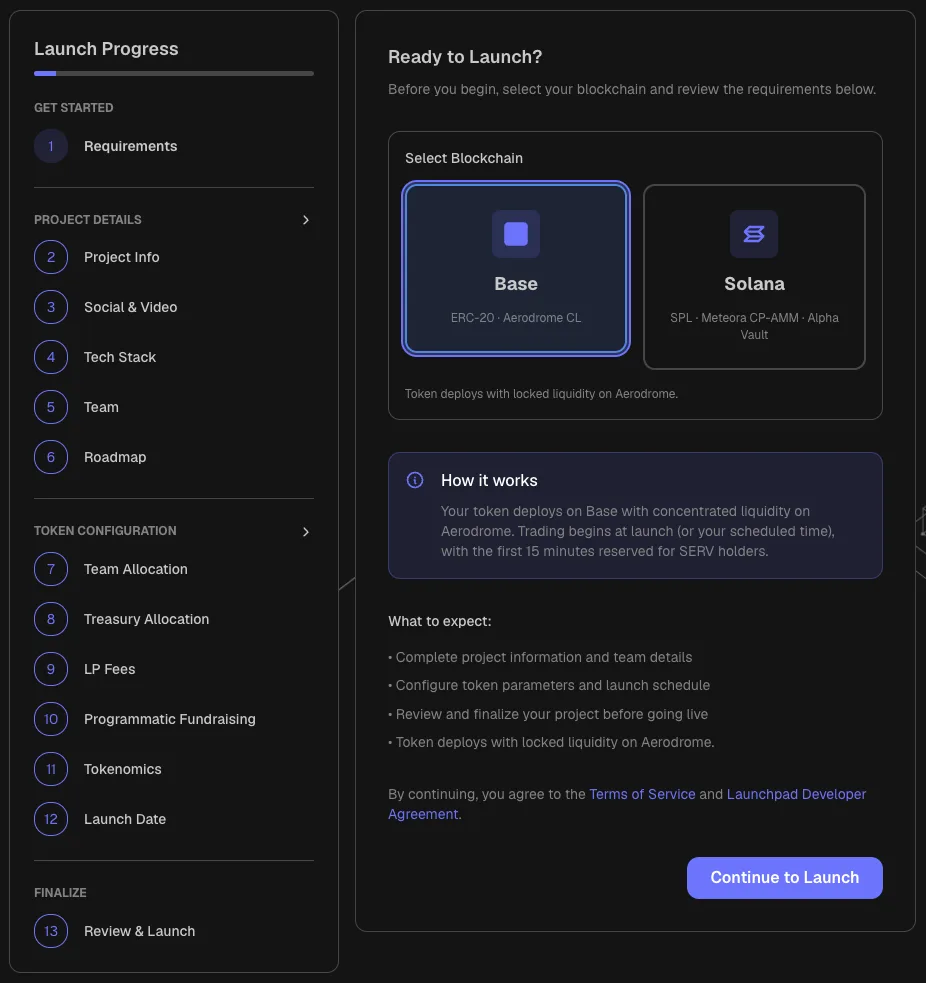
OpenServ can be configured for launch on both Base or Solana. The major difference in behavior is the DEX pool and launch sequencing setup.
Team Allocation
The team allocation configuration is a straightforward configurator for both cliff and unlock, where allocation is fixed at 20%.
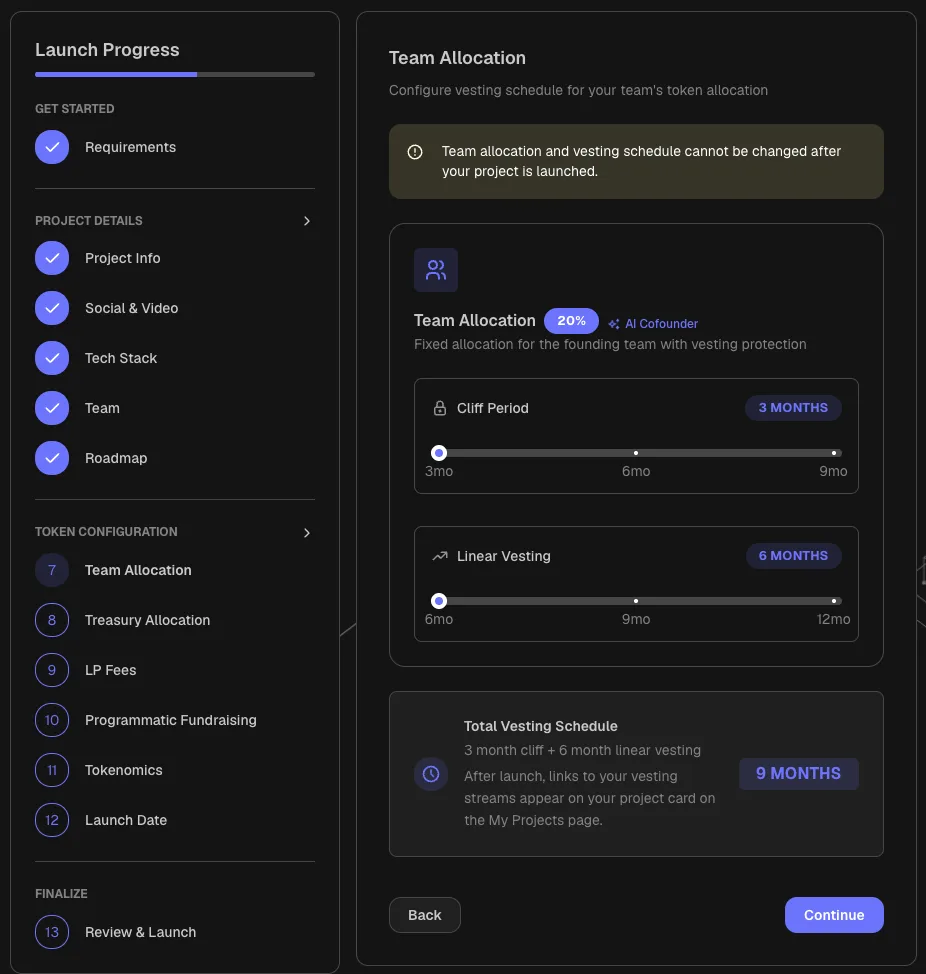
| Configuration | Fixed 20% supply allocation with an adjustable cliff (3 to 9 months) and linear unlock (6 to 12 months) |
|---|---|
| Considerations | Most projects will consider maximizing this to the absolute limit, selecting 9-month cliff and 12-month linear unlock (21 months total). Given the naturally high concentration of insider tokens on the platform, choosing the longest lockup available is the strongest way to prove long-term commitment to your community. |
| Enhancements | We’d love to see the ability to adjust the team allocation between 5% - 20%, as well as extending the initial cliff to 12mo, and linear unlock to 36mo |
Programmatic Fundraising
OpenServ’s programmatic fundraising is a built-in fundraising mechanism that allows for gradual liquidation of the token at fixed price bands (across predefined single-sided valuation bands ranging from $500K to $100M FDV), allocating 5% of total supply.
Their position is that a fair launch works because a project has to earn its capital by generating attention, volume, and revenue over time rather than receiving a lump sum on day one. Hand a team too much money upfront and that incentive, along with a chunk of the rug protection will disappear. Founders who need a fixed amount of committed capital before launch will find this structure constraining, and that’s the intended trade-off. Teams that want it should weigh programmatic fundraising against a more traditional raise.
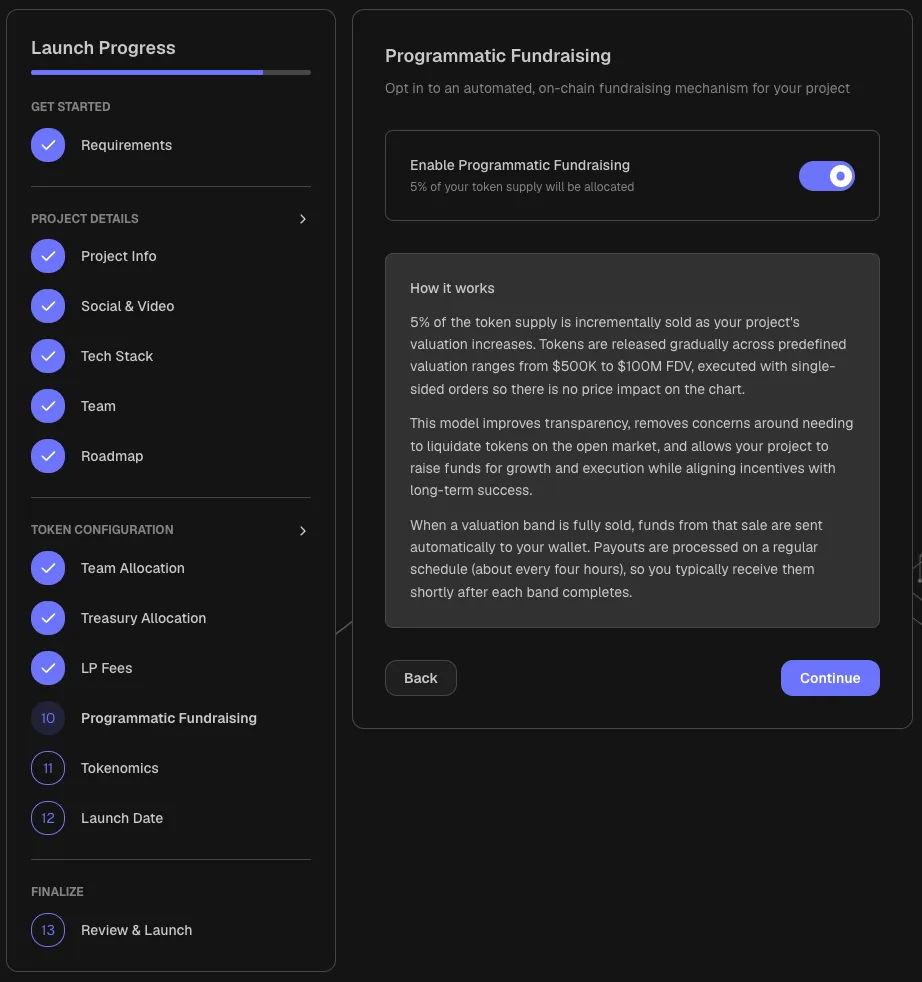
| Configuration | Toggle 5% allocation programmatic fundraising on / off |
|---|---|
| Considerations | While it’s the right train of thought to have price neutral and valuation gated liquidation, just be aware that this liquidation mechanism is rigid. The majority of teams may have difficulty raising meaningful funding from this mechanism with it so wide, and it also can create some issues with optics at 5% of total supply dedicated to liquidation. |
| Enhancements | Can explore configurable bands as well as allocation. Thinking further ahead - OpenServ can consider carving out an allocation for VC fundraising. There would need to be some considerations on how to manage the lockup schedule. |
Treasury Allocation
OpenServ’s treasury allocation is similar to what teams had called “ecosystem” or “ecosystem treasury” - this allocation can be tuned between 0-30%, along with cliff and unlock periods.
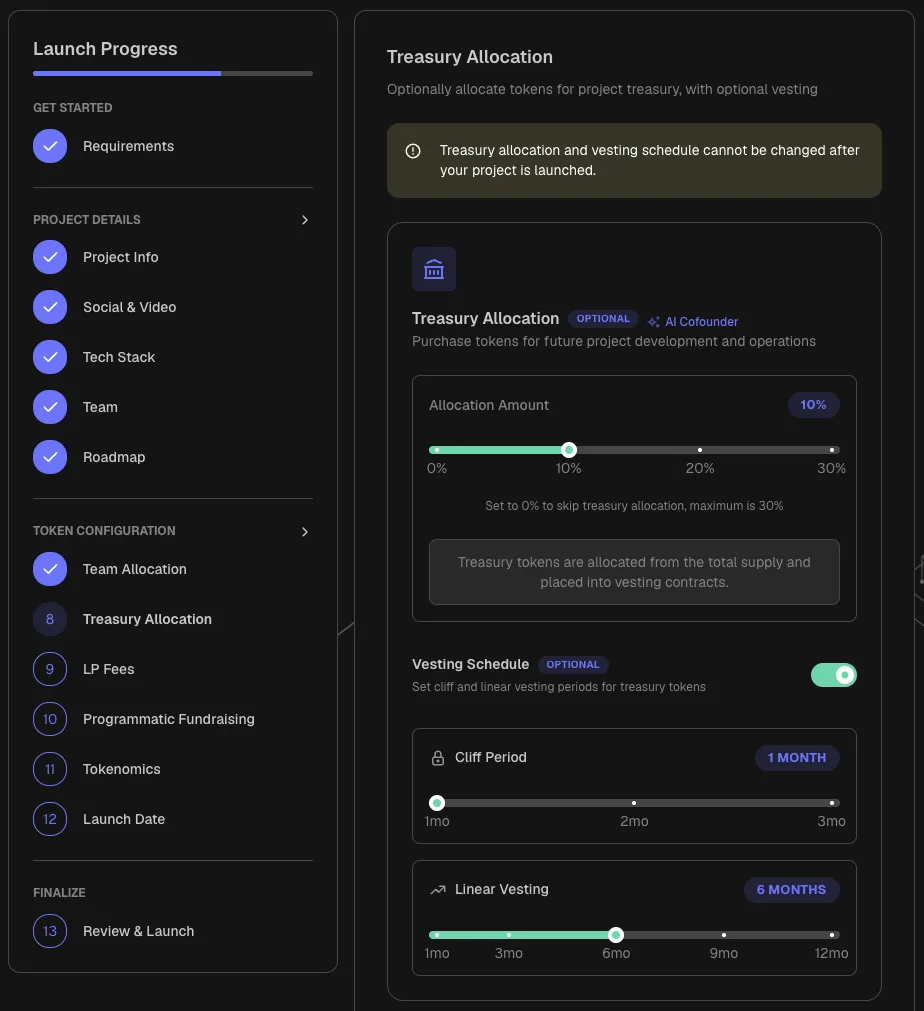
| Configuration | Variable supply allocation between 0% to 30% with adjustable cliff (1 to 3 months) and linear unlock (1 to 12 months). Leaving the vesting toggle off triggers an automatic 7-day cliff |
|---|---|
| Considerations | From an optical standpoint some teams might consider setting this allocation at 0%, especially with other mechanisms like LP fee share and programmatic funding as mechanisms to fund the business. If you decide to include this allocation, it is incredibly important to communicate transparently what your intentions are - most casual observers will simply assume this is pure sell pressure that the team will use to fund the business. |
| Enhancements | Configuration for this allocation is appropriate, but the nomenclature can be adjusted to improve optics. This can be named a variation between “Ecosystem” and “Community”, as teams might not use this allocation exclusively for project development or operations. We’d also recommend that the linear vesting configuration be extendable to 24mo or 36mo, more typical of a long term builder. |
LP Fees Configuration
OpenServ’s LP Fee configuration is straightforward, selecting between 1% and 2% LP Fees. In a permissionless market, nothing stops the community from spinning up cheaper secondary pools, and at 2% there is a theoretical incentive to do so. In practice OpenServ tells us this hasn’t been much of an issue: these trading fees flow back to supporting project development, so it’s generally well understood that concentrating volume in the main pool is better for the project over the long run. Teams should still size the fee with their own community dynamics in mind.
Note that the launch sequencing and DEX setup will be different depending whether
you’re launching on Base or Solana.
- Base - At launch, a single concentrated liquidity position on Aerodrome Slipstream is created, seeds it with the entire liquidity allocation, pairs with WETH, and locks that position for ten years. A small initial seed buy sets the opening price, and tokens start trading. The first 15 minutes are reserved for $SERV holders.
- Solana - Similar setup to Base, except liquidity sits on Meteora rather than Aerodrome with an Alpha Vault that qualified $SERV holders deposit SOL into ahead of launch to buy at the launch price.
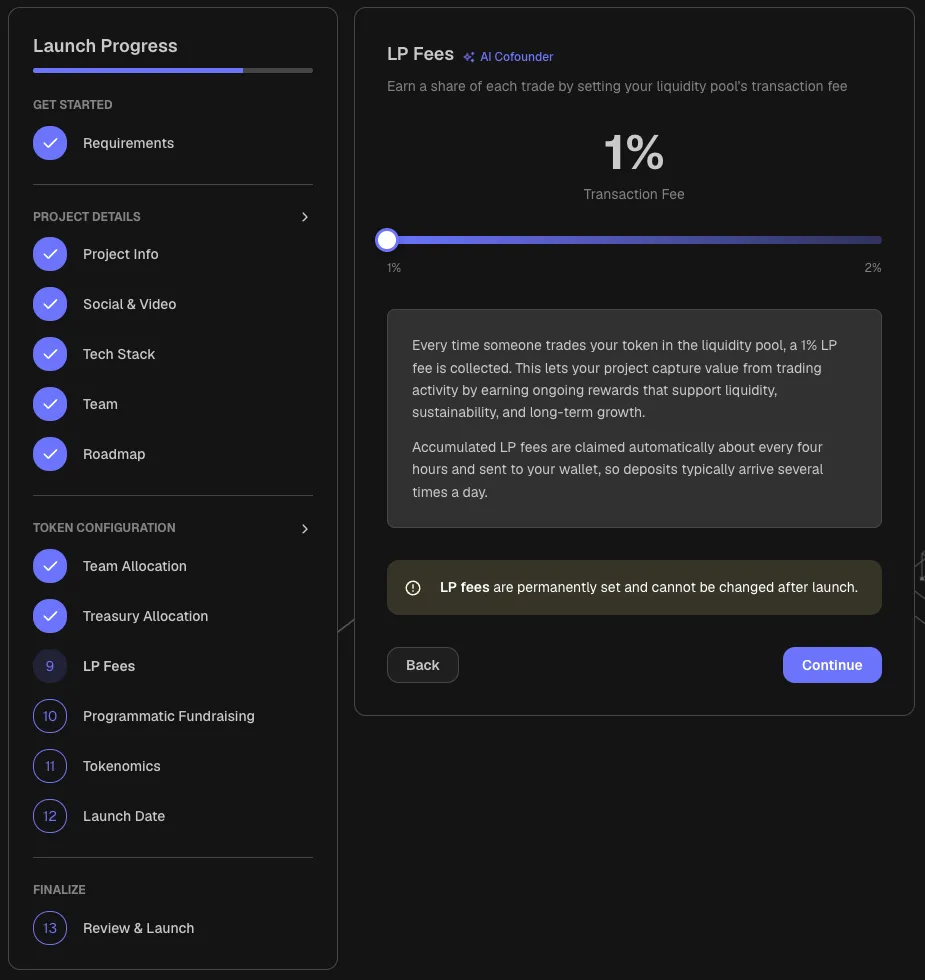
| Configuration | Either a 1% or 2% fee tier can be selected, locked over 10 years |
|---|---|
| Considerations | Most teams will select the 1% fee tier, to ensure trading is incentivized in the default pool instead of a different pool getting set up, as 2% is much too high. Fees are split 67% to creator and 33% to OpenServ and are claimed by the deployer wallet. Holders of 50k $SERV tokens get exclusive access to buy during the first 15 minutes, though the decaying burn still applies to their purchases. Early access is the perk, not a burn exemption (Base-only). |
| Enhancements | Adjust the LP fees to range between .7% - 1.5%, or simply remove the 2% option altogether. Specify in the configurator screen the 67/33 fee split. |
Launch Timing
OpenServ allows for an immediate launch, or a scheduling of the launch.
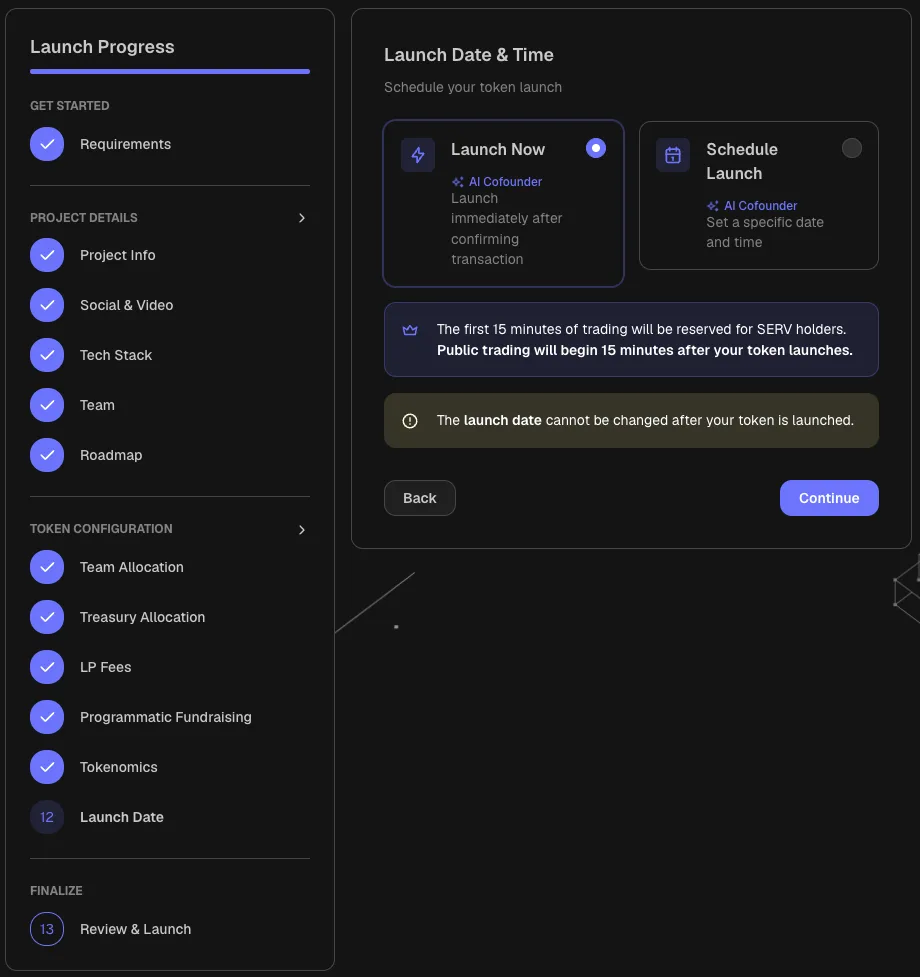
| Configuration | Two options, launch immediately, or pre-schedule a launch at a specified day/time |
|---|---|
| Considerations | Even though the timing for scheduled launches can be modified before the launch date, we’d still recommend picking “Launch Now” to ensure it is only launching the moment you are ready to go We’ve seen enough token launches that get delayed for one reason or another, so it’s always better to bring it live only when you are fully ready at that moment. The last thing you want is to have a configuration setup where the date/time is fat fingered and you forget to change it. |
| Enhancements | None |
Token Operations
While many projects launching on OpenServ are early stage, they should always be prepared for the scenario that the token does incredibly well. Permissionless launchpads only give you one shot and deployer wallets are hard coded, so if you lose access you cannot revert. Speed and ease of configurability should never replace proper opsec and token operations practices.
We’d recommend a collection of multisig wallets to be set up to support the token deployment, with at minimum 2 out of 3 signers required for any transaction.
Basic Wallet Setup for OpenServ Teams
| Wallet | Description |
|---|---|
| Deployer (LP Fees, Programmatic Fundraising) | Main wallet that you’ll use to set up and launch the token. Ensure this is a multisig wallet because the configuration will be hardcoded for the fee share and programmatic fundraising. Optional - if you’d like to keep LP fees and programmatic fundraising fees separated, you can consider creating a separate wallet for each of them, you’ll just need to manually claim or transfer on a regular basis. |
| Team | Single team wallet to receive tokens as they unlock from the Sablier contract. For distribution to team members, you’ll also want to have a token management platform managing this distribution. You can use Sablier to manage this as well. |
| Treasury Allocation | Single treasury wallet to receive tokens as they unlock from the Sablier contract. |
Beyond the wallet structure, a few operational practices are worth building into your launch checklist:
- Pre-fund the deployer wallet. It needs the 5,000 $SERV launch fee plus gas (ETH on Base, SOL on Solana) before deployment begins.
- Treat the deployer configuration as one-shot. The fee tier, fee-share recipient, and programmatic fundraising settings are hardcoded at launch and the LP locks for ten years, so a wrong address or tier cannot be fixed afterward. Triple-check and have a second pair of eyes before signing.
- Sweep proceeds on a schedule. LP fees and programmatic fundraising proceeds arrive in the deployer wallet automatically every four hours. Move them into treasury or cold storage on a regular cadence rather than letting balances sit in an operational wallet.
- Harden the signers. Put each multisig signer on a separate hardware wallet held by a different person, and never let one individual control a quorum.
- Label your wallets publicly. Tag the deployer, team, and treasury wallets on Basescan and Solscan and in your own docs, so the community can tell vesting and treasury movements apart from sell pressure.
- Monitor unlocks and pre-announce them. Track your Sablier cliff and unlock dates and communicate how unlocked team and treasury tokens will be handled, so a scheduled unlock doesn’t read as a surprise dump.
Launch Operations
As a project launching on OpenServ, it is critical to understand the exact sequencing of events after hitting “launch”. There are some important differences between Base and Solana launches as well.
Although OpenServ has thorough documentation on this launch sequencing, we’d recommend creating your own checklist and sequencing of events. You should know it inside out, and if you don’t, ask for help. You only have a single chance to get this token launch right.
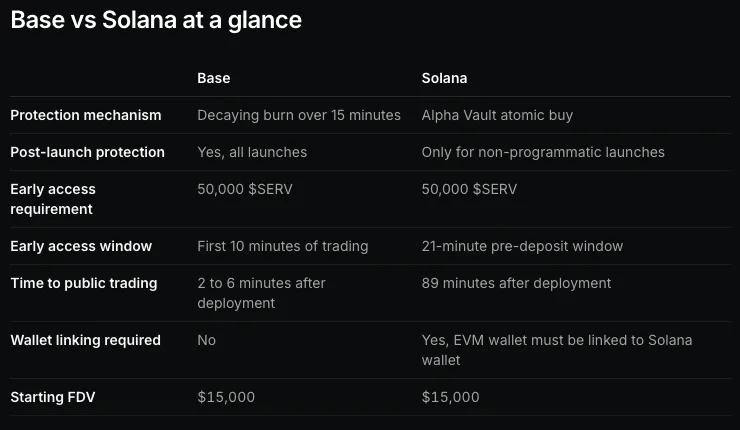
From OpenServ docs on launch process: https://docs.openserv.ai/launch/for-buyers
Base Launch Sequence
Base launches are designed for speed and live-trading bot mitigation. Your token becomes tradable almost immediately, but the first phase is reserved for the early access window. Once OpenServ launches become more popular, it remains to be seen if $SERV holding can be exploited by snipers for gain, although it’s unlikely to be an issue short term.
- Timeline: Public open-market trading begins extremely fast, usually 2 to 6 minutes after your initial on-chain deployment.
- Built-in Bot Protection: To protect your chart from snipers, OpenServ applies a "decaying burn" to tokens leaving your liquidity pool during this 15-minute window. The burn rate starts at a punitive 99% and linearly decreases to 0%.
- Early Access Window: During the first 15 minutes of live trading, OpenServ reserves all purchases exclusively for qualified $SERV holders (50,000 $SERV with a snapshot taken just before deployment). Note that these holders are still subject to the decaying burn.
- User Friction: Low. Early buyers do not need to link multiple wallets to participate.
Solana Launch Sequence
Solana launches utilize a pre-deposit "Alpha Vault" system. This guarantees early buyers secure the initial launch price, but it requires a longer lead time before public trading opens.
- Timeline: Due to underlying protocol lockups, public open-market trading will not begin until 89 minutes after your initial on-chain deployment.
- Early Access Window (Alpha Vault): Instead of live trading, qualified $SERV holders get a 21-minute window prior to the pool going live to deposit up to 3 SOL into the Alpha Vault.
- Execution and Bot Protection: When your pool officially activates, the vault executes a single, atomic purchase at the initial launch price for all early depositors. Additionally, a decaying anti-sniper fee is applied to the first 15 minutes of public trading (unless you enable programmatic fundraising).
- User Friction: Moderate. Early buyers must explicitly link their EVM wallet (holding their $SERV) to their Solana wallet on the OpenServ platform before the deposit window opens.
For more details, study the launch sequencing timelines in OpenServ’s launch documentation.
Keeping SERV Launch in Context
It’s worth closing where we opened: SERV Launch is a single tool in a much larger product suite, and it isn’t OpenServ’s center of gravity. The flagship is SERV Reasoning - enterprise inference infrastructure that sits between an application and the model, running each request through a structured reasoning blueprint to make AI agents more reliable, auditable, and cost efficient. Most of the builders and businesses OpenServ works with never launch a token at all; many sit outside crypto entirely, and the platform is already running in enterprise and government deployments.
SERV Launch exists to give the subset of builders who do want to raise a way to launch into a community of AI power users excited about businesses built on the SERV stack. We’d encourage founders evaluating the launchpad to read OpenServ’s material on SERV Reasoning as well, for the fuller picture of where the team’s focus and roadmap actually sit.
Finally, the parameters described here are a snapshot. OpenServ has been explicit that SERV Launch is built on builder feedback and that it’s actively iterating - refining the configurator, and open to adjusting defaults and vesting structures at the request of launch partners. Teams with specific needs should treat the template as a starting point and talk to the OpenServ team. If you’d like a second pair of eyes on your configuration before you sign, that is exactly what we do.
Sources
Primary sources
- OpenServ launch overview
- OpenServ guide for buyers
- OpenServ guide for builders
- OpenServ programmatic fundraising
- OpenServ staking
- What is SERV?
- OpenServ official site
Supporting mechanics
Ventari provides strategic and operational advisory services to token issuers. Ventari is not a law firm, broker-dealer, placement agent or registered investment adviser. Nothing on this website constitutes legal, tax, accounting or investment advice, or an offer or solicitation to buy or sell any security or digital asset. All execution and decision-making remain with the client, and clients are responsible for the legal and regulatory treatment of their tokens. Ventari works alongside client counsel.
Research published by Ventari is for informational purposes only and is not investment advice or a recommendation to buy or sell any asset.